
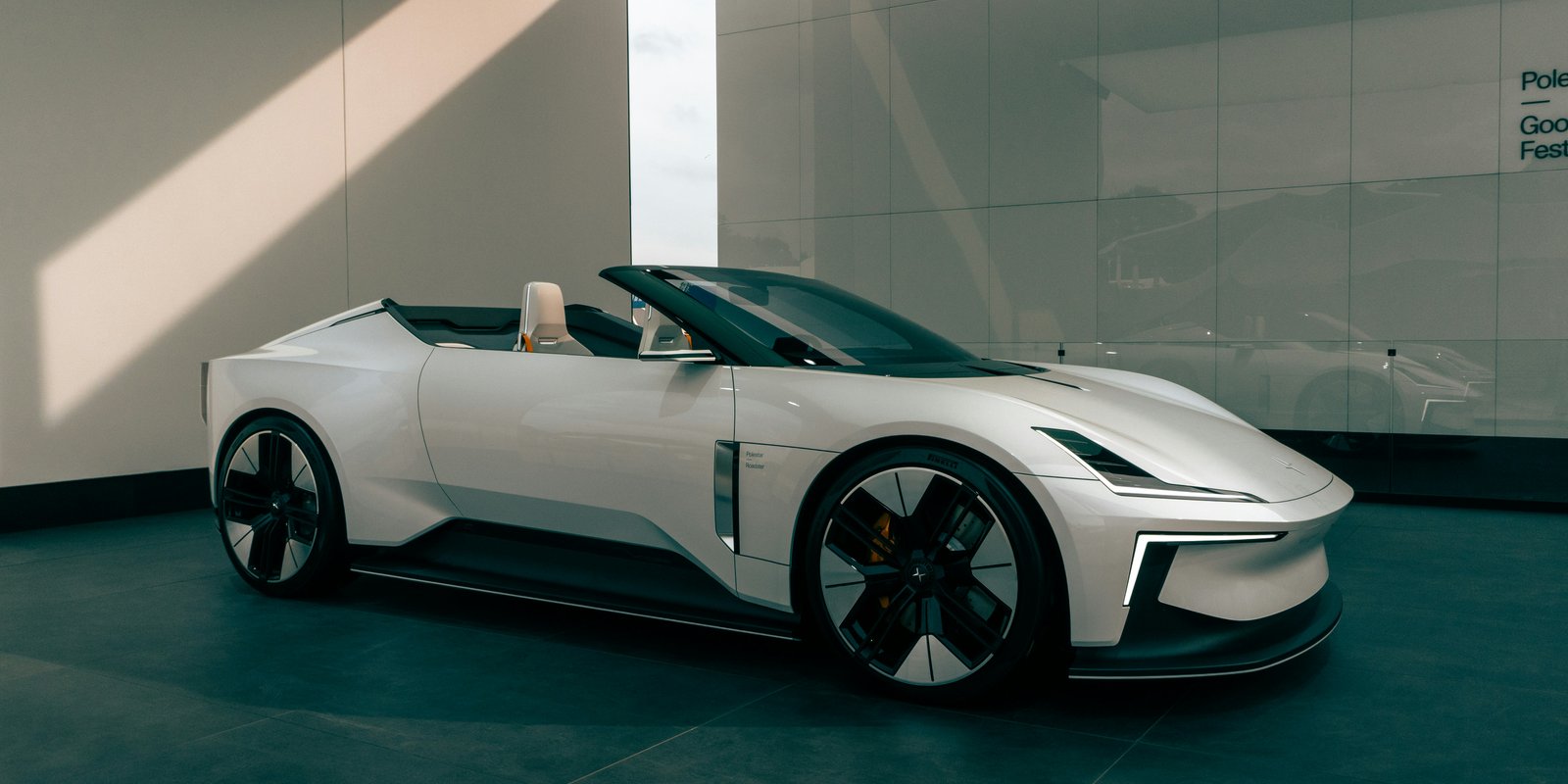

Polestar released a single teaser image of a design concept called Formula 2030 this month, its first move toward showing off a new design language ahead of a full reveal in October. One photo and a manifesto-sounding name is a modest way to kick off a design era. A single image ahead of a proper reveal makes sense to me. This is still a car in active development, and the final touches are still being worked out before it's ready to show properly. It's still meant to set the tone for two real production models: a Polestar 2 successor due in 2027 and the Polestar 7 compact SUV due a year later.
From what's visible, the familiar Dual Blade daytime running lights survive the transition, sitting inside bodywork that's noticeably more angular than anything currently in the Polestar range. Keeping that signature while everything around it changes reads as surface-level to me. It suggests continuity for its own sake rather than the ground-up rethink Polestar keeps describing this as. The stance sits low and wide, with the front wheels canted at a visible camber. There's also an S-duct built into the nose: a channel that pulls air in through the grille and pushes it out through a vent in the bonnet, using the airflow to press the front end down onto the road at speed. It's a trick lifted from race cars and hypercars, one that rarely survives contact with pedestrian-safety regulations and production headlight packaging. Whether it survives to production doesn't bother me much. Car technology has to keep moving forward, and a detail like this is part of that progression. The times change. Cars need to change with them.
Design boss Philipp Römers, who took over the role in January 2025, has been clear this isn't meant to be a clean break. He's called it a bold evolution rather than a revolution and told Autocar the goal is a car that's "ambitious, but not aggressive," a deliberate step away from the increasingly loud styling coming from rivals. That's an ambitious statement to make. Polestar wants to stand apart from the competition. I think that should work in its favour. Quality beats looks in the long run. Betting on that puts Polestar ahead of rivals still chasing looks over substance.
The teaser landed the same week Polestar posted its first-half 2026 results. Those numbers explain some of the urgency behind it. Retail sales crept up 0.4% to 30,423 cars while revenue fell 4.4% to $1.36 billion, even as losses narrowed to $842 million for the half. Polestar has already cut its full-year growth guidance from low double digits to low-to-mid single digits. Whether a sharper design actually fixes any of that depends on why sales are soft in the first place. If competitors are simply putting superior products on the market, a strong redesign could close that gap. If the problem is pricing, margin or something else entirely, a new look won't touch it.
Less attention went to what's arguably the bigger story here. The US Department of Commerce has blocked Polestar from selling model-year 2027 and newer cars under the Connected Vehicle Rule, a national-security regulation aimed at vehicles carrying Chinese-linked hardware and software. Existing stock and servicing can continue. New models are shut out of one of Polestar's key markets right as the brand needs volume most. I'm less worried about it than that sounds. The US economy is in strong shape overall. That gives Polestar room to succeed there even with this kind of regulatory setback.
One photograph and a mission statement aren't enough to judge a design era on. That verdict starts properly in October, when the full reveal lands and the Polestar 2 successor's actual shape starts to matter more than a teaser crop. Autocar's full interview with Römers is worth reading for the unedited detail. Polestar's own announcements sit on its official press site.